Tarot Journaling: How to Keep a Reading Journal That Makes You Better
A tarot journal is the single fastest way to improve. It turns scattered impressions into a record you can learn from — and it's the difference between reading the same card a hundred times and actually getting better at it.
Most people learn tarot by looking up meanings. That teaches you what the book thinks a card means — not what it means when you draw it, for a real question, on a specific day. A tarot journal closes that gap. It's a dedicated place to record your readings, your interpretations, and — the part almost everyone skips — what actually happened afterward. That last step is what turns a diary into a feedback loop.
Why journaling works (when meaning-memorizing doesn't)
Skill grows from feedback, and a journal is how you give yourself feedback. Three things happen the moment you start writing entries:
- Writing forces commitment. A vague impression (“something about change?”) collapses into a specific claim the moment you have to write a sentence. Specific claims can be right or wrong — and only things that can be wrong can be learned from.
- Follow-ups calibrate your intuition. When you note a week later how a reading played out, you find out where you were sharp and where you over-read. Do that fifty times and your confidence starts matching your accuracy.
- Patterns surface. Review a month of entries and you'll notice that the Tower shows up for you around decisions you're avoiding, or that you consistently read the Moon as fear when it's often just uncertainty. That's your personal deck vocabulary — and no book can give it to you.
The entry template (steal this)
You don't need a fancy format. You need a consistent one, so entries are comparable when you review them later. Here's a seven-line template that works for a single card or a full spread — copy it to the top of every entry.
💡 The two lines that matter most
First gut reaction captures your intuition before your thinking brain edits it — write it fast, before you look anything up. Follow-up is the whole point: leave it blank, and come back in a few days or weeks to record what actually happened. An entry without a follow-up is a diary; an entry with one is a lesson.
A worked entry (so you can see the voice)
Here's the template filled in for a real, ordinary question — the kind you'll actually journal. Notice the language stays plain and specific, and the follow-up is honest about what the cards got right and where the reader over-reached.


Date & mood: Tue, tired but okay
Question: How do I move forward after the job rejection?
Spread: Three-Card Daily (situation · advice · outcome)
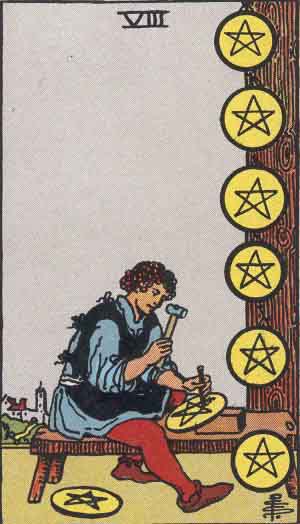
Cards: Situation — Five of Cups · Advice — Eight of Pentacles · Outcome — The Star
First gut reaction: “Stop staring at the loss.”
My reading: The Five of Cups names where I am — fixated on the “no” and ignoring the two cups still standing. The Eight of Pentacles as advice is refreshingly unglamorous: don't wait to feel inspired, just go back to the craft — reps, applications, one skill at a time. The Star as outcome says the point isn't a specific job, it's getting my hope back by staying in motion.
↩ Follow-up (2 weeks later): The advice landed — I set a “two applications a day” rule and felt human again by Friday. But I read the Star as “a better offer is coming,” and nothing has yet. Lesson: I keep turning outcome cards into predictions. The Star was about renewed hope, not a guaranteed result — read it as a state, not a forecast.
That follow-up is worth more than the reading itself. It caught a specific, repeatable habit — turning outcome cards into predictions — that the reader can now watch for. That's the compounding return of journaling.
Seven journaling techniques & prompts
Once the basic entry is a habit, these formats keep the practice alive and target different skills. Rotate through them — variety is what stops journaling from becoming a chore.
1. The daily draw
One card each morning: “What should I keep an eye on today?” Write a one-line prediction. At night, add one line on how it actually showed up. It's five minutes and it builds more fluency than anything else, because you get a fresh prediction-and-check every single day.
2. The card study page
Give one card its own page. Write the keyword you were taught, then your version in a sentence, a time it showed up for you, and one question it tends to ask. Do this for cards that keep confusing you — pairs like the Queen of Cups vs the Queen of Wands untangle fast when you write them side by side.
3. The reversal / shadow log
Keep a running list of every reversal you draw and how you read it — blocked energy, the inner version, “not yet,” or simply emphasis. Over time you'll develop a consistent, personal approach to reversals instead of guessing each time.
4. The prediction & accuracy tracker
For any reading with a testable outcome, write the prediction and a date to check it. When the date comes, score it honestly: right, wrong, or too vague to score. “Too vague to score” is the most useful result — it teaches you to make falsifiable reads.
5. The question journal
Before you shuffle, write three versions of your question and pick the sharpest. Bad readings usually start with fuzzy questions; journaling the question first fixes more readings than any interpretation trick.
6. The deck interview
New deck? Draw a few cards to prompt free-writing: What are you good at showing me? Where are you blunt? What do we need to work on? It's really a structured way to write down your first impressions of a deck's art and voice so you can watch your relationship with it evolve.
7. The “two cards, one seat” drill
Pick a position (say, Advice) and journal how three different cards would each read in that exact spot. Writing the contrast trains the most important reading muscle there is: meaning changes with position, never in isolation.
Paper vs digital — and a note on searchability
📔 Paper
Slower, which is a feature — handwriting helps memory and invites reflection. Great for the daily draw and card study pages. The catch: you can't search it, so patterns are harder to find.
💻 Digital
Searchable and taggable — you can pull up every entry where a card appeared and read your own history of it. Ideal for the accuracy tracker and pattern review. The catch: it's easier to skip the reflection.
Plenty of readers keep both — paper for reflection, something searchable for pattern-spotting. If you're building the habit online, it helps to have a low-friction way to draw a card, write up your read, and get a second opinion in the same place you're logging it. That's exactly what the practice tool below is for — draw, interpret in your own words, and get instant feedback, no signup required. Treat its feedback as a follow-up note you don't have to wait a week for.
The weekly review (where the learning happens)
Writing entries is only half of it. Once a week, spend ten minutes reading back over them and answer four questions:
- Which cards repeated? Repetition is the deck underlining a theme.
- Where was I right, and where did I over-read? Check your follow-ups honestly.
- Which readings started from a fuzzy question? Those are the ones that went nowhere.
- What's one card I want to understand better this week? Give it a study page.
💡 Monthly zoom-out
Once a month, skim the whole month at once. You're not reading individual entries now — you're looking for the storyline: a recurring worry, a card that keeps chasing you, a question you keep asking in different words. That's often the reading your journal has been trying to give you all along.
Common journaling mistakes to avoid
❌ Copying the book meaning into your entry.
✅ Instead: Write what the card means here, for this question. If you wanted the book, you'd read the book.
❌ Never filling in the follow-up.
✅ Instead: Put a reminder in your calendar. The follow-up is the feedback — skip it and you're journaling with your eyes closed.
❌ Writing only when a reading feels “important.”
✅ Instead: Log the boring daily draws too. Fluency is built on volume, and small consistent reps beat rare marathon sessions.
❌ Keeping it so vague nothing can be checked.
✅ Instead: Commit to one specific read per card. A wrong-but-specific entry teaches you something; a safe-but-vague one teaches you nothing.
Now you try
The best way to start a journaling habit is a single entry. Draw a Three-Card Daily below, write up your read in your own words — situation, advice, outcome — and you'll get instant feedback to save as your first follow-up note. No signup needed. Then copy the template above into a notebook or a doc and do it again tomorrow.
Try the Three-Card Daily now
Your seeker
Elena. I found old love letters in my fiancé's jacket from his 'best friend' who's also my maid of honor. Six weeks before my wedding, I'm questioning everything I thought I knew.
“Should I have a difficult conversation with my friend about something that's been bothering me?”
1 of 3
Situation
What's happening now? The current energy, circumstances, or challenge you're facing.
Feedback on your reading: strengths, blind spots, what to sharpen · free · no signup
Prefer one big text box?
FAQs
What should I write in a tarot journal?
At minimum: the date, your question, the spread and cards, your interpretation in your own words, and how you felt. The highest-value habit is leaving room for a follow-up note later — that's what turns a diary into a feedback loop.
Paper or digital?
Whichever you'll actually keep up. Paper aids memory and reflection; digital is searchable so you can track patterns across every entry. Many readers use both. Consistency matters more than format.
How often should I journal?
Log every real reading, plus a quick daily one-card draw if you want steady reps. One honest sentence a day beats a page once a month — then review weekly, which is where most of the learning happens.
Does journaling really make you better?
Yes. Writing forces you into a specific interpretation instead of a vague impression, follow-ups show where you were sharp or over-read, and reviewing entries reveals your personal patterns for each card.