Six of Cups
Learn the Six of Cups tarot card meaning. Discover upright and reversed interpretations for this cups card in love, career, and personal growth readings.
Six of Cups in your reading
The Card Imagery
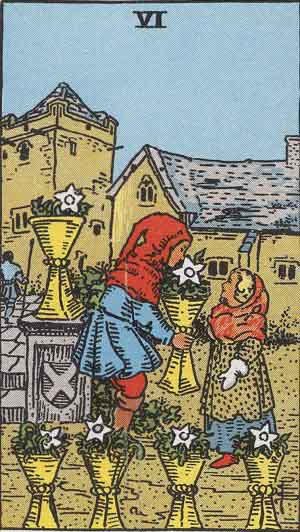
A child offers a cup filled with flowers to a smaller child. Six cups filled with flowers surround them in what appears to be a garden of a family home.
Six of Cups Upright Meaning
The Six of Cups represents nostalgia, innocence, and happy memories. A return to simpler times or a reunion may be at hand.
Upright Keywords:
Six of Cups Reversed Meaning
Reversed suggests being stuck in the past, unrealistic expectations, or outgrowing old relationships.
Reversed Keywords:
Got the core?
A seeker keeps thinking about an old friendship she let drift. She draws the Six of Cups upright in a general reading and asks what it means. What is the grounded read?
What's your read?
Six of Cups in Specific Readings
The question changes the card. These guides go deep on Six of Cups in the readings people ask about most:
Six of Cups in Context
The same card reads differently depending on what the seeker asked. Here's how Six of Cups tends to land in the most common reading areas — tendencies to weigh, not verdicts.
Six of Cups in Love & Relationships
Upright: In a love reading, the Six of Cups often points to the past walking back in: an ex reaching out, a reunion, or a connection with someone who feels instantly familiar. In an established relationship it can be a genuinely sweet card — revisiting what made you two work, old warmth resurfacing. The question to sit with: is this a bond that still gives back, or affection for a memory? The card shows the pull; it doesn't promise the past improved while you were gone.
Reversed: Reversed in love, it usually reads one of two ways: finally releasing an old relationship — the nostalgia loosening its grip — or the opposite, clinging to someone who exists more in memory than in the present. It can also flag a relationship being unfavorably compared to an idealized past one. Look at the surrounding cards to tell release from clinging; the reversal only says the past is under negotiation.
Six of Cups in Career & Work
Upright: At work, the Six of Cups can point to returning to something: a former employer or colleague reappearing, an old project revived, or a skill from years ago becoming relevant again. It also favors work connected to children, teaching, craft, or anything with roots in what you loved before it was a career. It can gently ask whether comfort at work has become the reason to stay.
Reversed: Reversed in a career reading, it often describes staying somewhere because it's familiar rather than because it still fits — the job version of living in the past. It can also mark the healthier flip: outgrowing an old role and being ready to move on. If a return offer is on the table (a boomerang job, a revived venture), reversed suggests checking whether the place you'd return to still exists outside your memory of it.
Six of Cups in As Feelings
Upright: As how someone feels about you, the Six of Cups tends to read warm and tender: you remind them of something safe — home, first love, being young. They may feel real affection and nostalgia in your presence. The nuance a careful reader adds: feeling like the past can mean cherished, and it can mean familiar rather than exciting. The cards around it usually say which.
Reversed: Reversed as feelings, it can mean someone is stuck on who you used to be together rather than who you both are now — or that they're actively letting the old version of the connection go. It sometimes surfaces when one person has moved forward and the other is still reading from the old script.
Six of Cups in Money & Practical Matters
Upright: Practically, the Six of Cups leans toward gifts, family help, inheritances, and generosity that flows without a ledger — money with feeling attached. It can also point to income from nostalgia itself: childhood skills, vintage things, work that trades on memory and comfort.
Reversed: Reversed, watch for the financial version of living in the past: spending to recreate old comfort, supporting an old obligation that no longer makes sense, or expecting help that used to come and no longer does. It can also mark finally putting an old family money entanglement to rest.
Reading Six of Cups in Practice
The Six of Cups is often taught as nostalgia, childhood, innocence, or the past returning. Those meanings are accurate, but the card becomes much sharper when you understand its function: it shows feeling moving through familiarity. Something old, known, tender, or formative is re-entering the present. The querent may be returning to a prior emotional state, meeting someone from the past, remembering who they were before cynicism, or encountering an old imprint that still shapes what feels safe and lovable.
That is why this card can feel so sweet and so dangerous. In its healthiest form, it restores tenderness, trust, generosity, and emotional sincerity. It can describe reconnection, gifts from the past, genuine innocence, or the relief of being with someone who does not require armour. In more shadowed expressions, it can describe regression, idealised memory, arrested development, or the inability to distinguish what is familiar from what is actually good now.
Compared with the Five of Cups, the past is no longer only a site of grief. Memory becomes active in a different key: tender, formative, or emotionally magnetic. Compared with the Two of Cups, the emphasis is not pure reciprocity but emotional familiarity and remembered resonance. Compared with the Seven of Cups, the image is not diffuse fantasy but a more specific return of emotional memory, softness, or imprint. The Six of Cups feels embodied and recognisable, even when it is not entirely mature.
This card often appears when the past re-enters the reading in a living way. A former lover might return. Childhood patterns may reactivate. A creative practice that once nourished the querent may call them back. Family history, homesickness, or old friendships can become newly relevant. The key reading question is not merely 'what from the past is here?' but 'what does this return awaken emotionally, and is that awakening supportive, distorting, or unfinished?'
The exchange of cups in the card matters because it suggests emotional giving that feels simple, open, and unguarded. Yet the innocence here is not automatically purity. Sometimes what feels innocent is only familiar. Readers must be careful not to confuse sweetness with wisdom. The Six of Cups can absolutely heal, but it can also tempt the seeker into repeating old emotional positions that once felt safe because they were known, not because they were healthy.
In reversal, the nuance deepens further. The card may show nostalgia becoming distorted, immaturity, clinging to the past, unresolved childhood imprinting, or a return that reopens old dependency. It can also show an effort to break from sentimental fixation, to grow beyond old scripts, or to see the past more truthfully after idealising it. Reversal asks whether the past is nourishing the present, haunting it, or finally being seen without the soft filter that kept it emotionally powerful.
Three Things to Hold
The past is emotionally present
Six of Cups does not only mean remembering. It means familiarity, tenderness, or old imprinting is actively shaping the present field.
Familiar is not the same as healthy
Something can feel sweet, safe, or innocent because it is known. Your job is to ask whether the return is nourishing or regressive.
Read the emotional age of the moment
This card often reveals when a younger part of the self, an old bond, or an unresolved imprint has come back into the room.
Common Mistake
Beginners often read this as “happy nostalgia” or “an ex coming back,” then stop there. Replace that with a better question: what emotional memory, innocence, or unresolved familiarity is returning — and what is it asking the seeker to do now?
Reading Questions
- • What from the past is returning here: a person, an emotional pattern, a place of innocence, or a formative wound softened by familiarity?
- • Does the return feel nourishing, reparative, and sincere — or overly idealised, immature, or regressive?
- • What younger emotional self may be active in the seeker's response?
- • If the card is reversed, where might nostalgia, unresolved imprinting, or distorted innocence be shaping the reading?
Example Reading
Question:
“Should I reconnect with someone from my past?”
Interpretation:
The Six of Cups brings warm memories. Reconnection can be healing, but ensure you're meeting the person they are now, not just who they were.
Related Content
Related Cards:



Try These Spreads:
Knowing Six of Cups isn't the same as reading it
The fastest way to make this card stick is to use it in a real reading. Our free tarot exercises put Six of Cups — and every other card — in front of you with a real seeker and a real question, then give you feedback on your interpretation.
Try the tarot exercises →Learn Six of Cups properly
Take the interactive Six of Cups lesson: learn it upright and reversed, then read it for a real seeker and get instant feedback.
Start the Six of Cups lesson →