Eight of Cups
Learn the Eight of Cups tarot card meaning. Discover upright and reversed interpretations for this cups card in love, career, and personal growth readings.
The Card Imagery
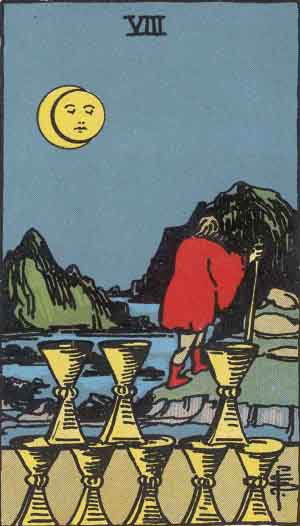
A cloaked figure walks away from eight stacked cups under a crescent moon, heading toward distant mountains. The cups represent what's being left behind.
Eight of Cups Upright Meaning
The Eight of Cups represents walking away in search of deeper truth. Sometimes you must leave what's comfortable to find what's meaningful.
Upright Keywords:
Eight of Cups Reversed Meaning
Reversed indicates fear of change, aimless drifting, or indecision about leaving.
Reversed Keywords:
Reading Eight of Cups in Practice
The Eight of Cups is often summarised as walking away, abandonment, or quitting. That is not wrong, but it is not yet deep enough. The card's real function is to show a deliberate emotional departure: the seeker turns away from something they have invested in, not because it is broken, but because it has stopped nourishing them. The cups are already stacked — effort has been spent, something has been built — yet a part of the seeker knows that staying would mean settling for an arrangement that no longer holds real meaning.
That means this card is rarely about dramatic rupture. It is about the quiet, sober choice to leave what is merely adequate in order to seek what is genuine. The seeker may feel grief, loneliness, relief, or uncertainty, but the essential movement is inward truth overriding outward appearances. The reading must ask what the seeker is leaving, what they are walking toward, and whether the departure is guided by honest discernment or by an old habit of exiting whenever things become difficult.
In a constructive form, this card supports emotional honesty, maturity, and the courage to refuse a life that looks complete but feels empty. It honours the knowing that enough is enough. In its shadow forms, it can become chronic avoidance disguised as a search, restlessness that leaves before anything can be learned or repaired, or a noble exit-story the seeker tells to escape ordinary discomfort. The reader must ask: is the seeker leaving toward something real, or simply away from something they do not want to feel?
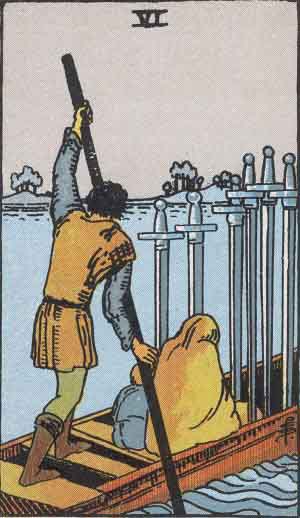
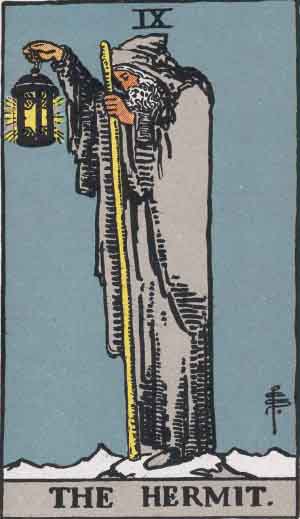
Compared with the Five of Cups, the loss here is chosen rather than suffered: the Five grieves what spilled, while the Eight voluntarily leaves what remains. Compared with the Six of Cups, the movement is away from the present rather than back toward the past. Compared with the Seven of Cups, the fog of many imagined options has resolved into a single, decisive turning away. Compared with the Hermit, there is overlap in the solitary search, but the Hermit withdraws into reflection while the Eight departs from a specific situation that no longer fits.
The image matters because it shows investment and incompletion together: the cups are arranged with care, yet there is a gap, and the figure walks toward distant mountains under a clouded moon. This is leaving guided by inner knowing rather than daylight certainty. A strong reading does not merely say 'time to move on.' It asks what has quietly gone missing, what the seeker hopes to find, and whether they are honouring their depth or running from it.
In reversal, the card can go in more than one direction. Sometimes the seeker is afraid to leave and stays stuck in what no longer serves them, clinging out of fear or obligation. Sometimes they drift without direction, leaving but not truly seeking. Sometimes they turn back toward what they had already outgrown. Reversal can also mark the moment courage finally arrives after long hesitation. The job is to read whether the reversal shows fear of departure, aimless wandering, a pull to return, or the threshold of an overdue leaving.
Three Things to Hold
This card is about conscious departure
Eight of Cups shows the seeker choosing to leave something they have built because it no longer offers real meaning, even when it still looks fine from outside.
Leaving is not the same as failing
The card can appear when walking away is the mature, honest move. Read whether the departure honours the seeker's depth or merely avoids discomfort.
Direction is the medicine
The reader's job is to separate seeking from escaping — to ask not only what is being left, but what the seeker is actually moving toward.
Common Mistake
Beginners often read this as “giving up” or “abandonment” and stop there. Replace that with something more exact: what has quietly stopped nourishing the seeker, what are they walking toward, and is this departure honest seeking or habitual avoidance?
Reading Questions
- • What is the seeker leaving, and why does it no longer feel like enough?
- • Are they walking toward something meaningful, or mainly away from something uncomfortable?
- • What has quietly gone missing here that outward appearances do not show?
- • If the card is reversed, is the seeker afraid to leave, drifting without direction, pulled to return, or finally ready to go?
Example Reading
Question:
“Should I walk away from this situation?”
Interpretation:
The Eight of Cups says your heart already knows the answer. When something no longer fulfills you, staying serves no one. Trust the call to seek something deeper.
Related Content
Related Cards:
Try These Spreads:
Knowing Eight of Cups isn't the same as reading it
The fastest way to make this card stick is to use it in a real reading. Our free tarot exercises put Eight of Cups — and every other card — in front of you with a real seeker and a real question, then give you feedback on your interpretation.
Try the tarot exercises →Learn Eight of Cups properly
Take the interactive Eight of Cups lesson: learn it upright and reversed, then read it for a real seeker and get instant feedback.
Start the Eight of Cups lesson →