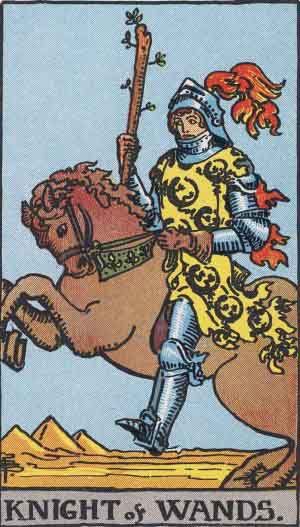
Knight of Wands as Advice
You asked what to do, and Knight of Wands answered. Here's the action it points to.
The short answer
Act now, and act big. Stop rehearsing and make the bold move.
- →Aim the charge before you spur the horse. Pick one target, not five.
- ReversedYou are revving in neutral. Find the block, or stop scattering.
Tell me moreShow less
As advice, the Knight of Wands says go. Send the application, book the trip, say the thing. You have been circling and the card wants you to charge. The one condition it adds: aim first. A bold move at one target beats a wild swing at five.
Knight of Wands Upright As Advice
Upright, the Knight of Wands as advice is one of the most direct answers in the deck: make the bold move now. Not after more research. Not once you feel ready. The rider on the card is already at full gallop, and the advice borrows that motion. If you have been waiting for a sign, this is the least subtle one you will get.
Signs to look for
- You have been circling: the same draft or plan, redone again.
- You can name the one target in a single sentence.
- The application goes out, the trip gets booked, the thing gets said.
Tell me moreShow less
Now the part that keeps the advice from being reckless. Look at where the knight is riding: dry hills, no road drawn in. Drive without a target burns fuel and goes nowhere. So before you charge, name the one thing you are charging at. One application, not twenty. One conversation, not a campaign. The Knight is at his best pointed at a single goal he can actually reach.
A last honest note. Advice to be bold is not advice to be careless with other people. Speed is yours to spend; the fallout lands on everyone. Make the move, and make it in a way you can stand behind next month. Try a few practice readings where the Knight lands as advice, and notice how often the answer is "go" and how often it is "go, but at one thing."
Read it yourself
uprightA seeker has drafted the same pitch email to a dream client four times without sending it. She asks what to do and the Knight of Wands lands as advice.
What's your read?
Knight of Wands Reversed As Advice
Reversed as advice, the Knight of Wands says you are revving in neutral. All the fire is there and none of it is moving anything. Either you keep starting things and abandoning them, or you are stuck behind a block and pushing harder does nothing. The advice is not "charge anyway." It is to find out which of those two you are in.
Signs to look for
- Three half-started projects, none of them finished.
- Pushing harder changes nothing; something you can name is blocking the drive.
- You are snapping at people: drive with no outlet.
Tell me moreShow less
If you are scattered, the fix is subtraction. Pick one thing and let the rest wait. Three half-started projects are three ways to feel busy while nothing finishes. If you are stalled, the fix is honest naming: what exactly is holding the drive back? A fear, a missing skill, someone else's timeline? Reversed also carries a temper. If you have been snapping at people, that is the drive with no outlet, and it needs one.
Either way, reversed advice is slow-down advice for a fast card, and beginners hate it. The Knight of Wands lesson ends with exactly this reversed story: someone "flooring it in neutral." Reversals reward a second look before you act on them.
Read it yourself
reversedA seeker started a podcast, a newsletter, and a course this quarter. All three are half-built. He asks what to do next and draws the Knight of Wands reversed as advice.
What's your read?
How to Read It More Precisely
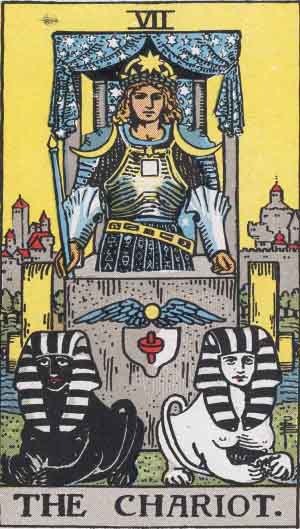
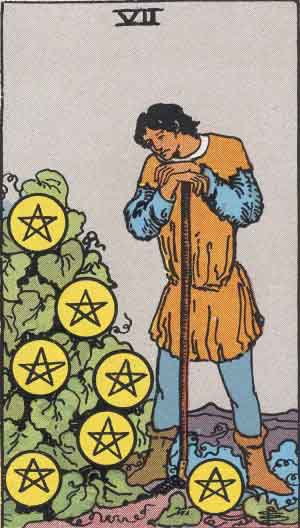
The neighbor sets the pace. Beside the Chariot, go: the drive has a direction and you can steer it. Beside the Seven of Pentacles, the drive is real but needs pacing so it does not burn out before it lands.
Advice position changes the grammar. As advice, this card is an instruction: move. In an outcome position, it is a forecast: things speed up. Read the instruction as a forecast and you will sit waiting for momentum the card told you to go make.
The one-target test: can you say in one sentence what you are charging at? If the answer needs a list, you are not aimed yet, and the Knight becomes his own reversal fast.
Aim the charge before you spur the horse.
Your turn: a practice read
Your turn: aim the charge on a live question.
A seeker has wanted to open a small bakery for years. He has savings, a recipe people line up for, and a spreadsheet he keeps adding tabs to. He pulls one card as advice and gets the Knight of Wands upright.
“What should I do about the bakery?”
The card on the table: Knight of Wands. What's your read?
One rep down. The full lesson hands you a seeker with no options to pick from, and you get feedback on the read you write yourself.
The lesson · try it right here
Read Knight of Wands yourself, with feedback
Pages tell you tendencies. A reading asks you to weigh them for one person, in one situation. That's the skill, and you can learn it.
Drive in Motion
The usual misread: “It's the Knight of Wands — so it's the go card, charge full speed, it's bound to work out.”
Common Questions
Does the Knight of Wands as advice mean I should quit my job?
It means make the bold move you have been circling, and only you know what that move is. For some people that is quitting. For most it is the smaller, scarier step that quitting has been standing in for: the conversation, the application, the side project launched in public. Name the one target first. A Knight without a target is just a person who quit. Guided scenarios let you rehearse the call before it is your own life.
What if I am already an impulsive person? Is the Knight still telling me to charge?
Probably not, and this is where honest reading matters. If your pattern is fast starts and fast exits, the Knight is more likely holding up a mirror than handing you a green light. Read it as a check: is this drive aimed at something reachable, or is it the same rush you have ridden before? For an impulsive reader, the advice often lives closer to the reversed meaning: pick one thing and finish it.
Try reading Knight of Wands yourself
Meanings only stick when you use them. Our free tarot exercises give you a real seeker and a real question — you read the cards, and get feedback on your interpretation. New to this? Start with how to practice tarot, the 15-minute daily loop.
Try the tarot exercises →